DataKnobs

Data-driven action

A user has data. They want a task done. What has to happen in between?

It sounds like the simplest possible shape for a data product — data comes in, a task gets stated, something happens. Most of the time it breaks not because the data was missing, but because the task was never really a task, or nothing was actually set up to act on the answer.

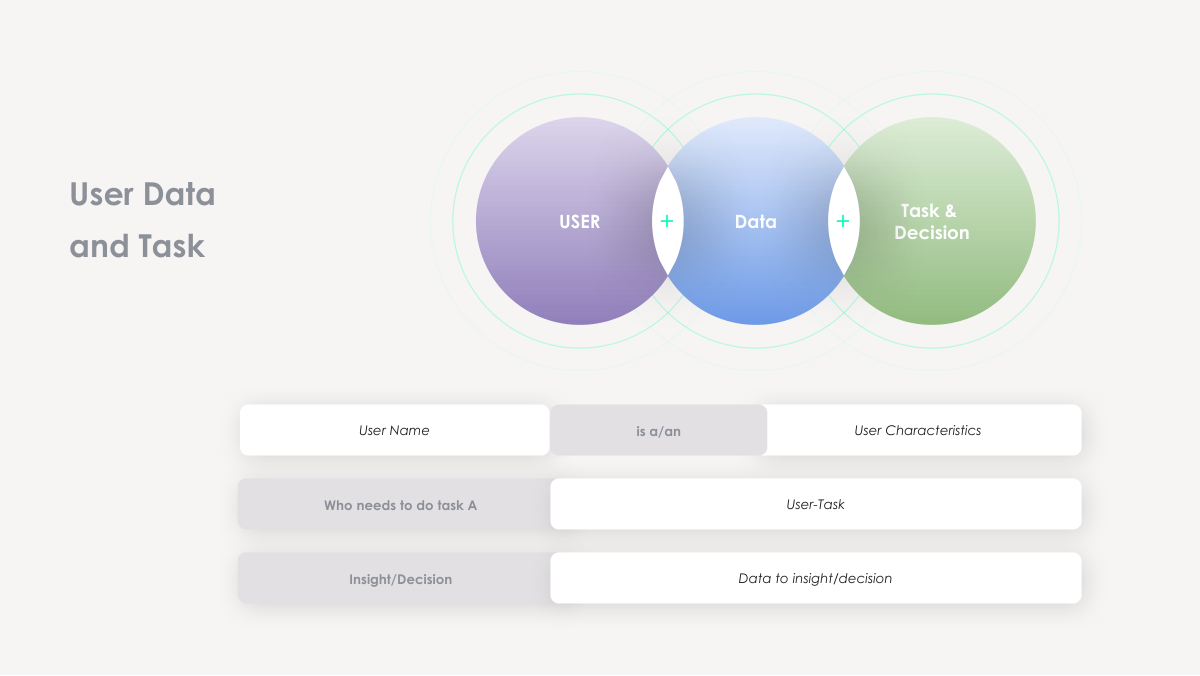
Opening slide of a presentation on data-driven tasks and actions
Title slide from the source deck. It carries its own text, so it opens full size in a new tab rather than being read at page scale.

The chain

Data, task, action — all three, or none of it counts

01 — Data

What you have

Not "big" or "clean" in the abstract — specific enough, relevant enough, and complete enough for the exact task about to be asked of it.

02 — Task

What you're deciding

A decision or action to take, with a clear shape and an owner — not an open question with no stopping point.

03 — Action

What changes

Something in the world is different afterward: a decision made, a workflow triggered, a value updated — not just a chart rendered.

01

Data: sufficient for this task, not data in general

A dataset can be large, clean, and well-governed and still be the wrong data for the task sitting in front of it. Readiness is relative — a churn dataset that's perfect for identifying which customers are leaving may be missing the one field that would let you decide what to actually do about it.

The question worth asking isn't "do we have data." It's "do we have the specific slice of data — the right time window, the right segment, the right outcome label — that this particular task depends on."

02

Task: a decision, not a question

"Show me what's interesting in this data" has no stopping point, no owner, and no way to know afterward whether it succeeded. "Should we discontinue this product based on the last two quarters of returns" has all three — a yes-or-no shape, someone responsible for acting on the answer, and a criterion for having gotten it right.

Most requests that feel like they're missing data are actually missing this. The data was available the whole time; nobody had stated a decision specific enough for it to answer.

03

Action: something changes, and someone owns it

An emailed report with no assigned recipient and no defined next step isn't an action. It's a notification, and notifications with nobody accountable for them get ignored at a predictable rate. A real action either triggers automatically — an alert, a routed workflow, a value update — or lands with a specific person whose job includes acting on it.

This is the link that's easiest to skip, because it's the one that requires committing to a process rather than shipping an analysis.

Signature tool

Check a request against all three

Pick one of six real-sounding request phrasings below and see which of data, task, and action actually holds — and which is doing the quiet work of making the whole thing fail.

Getting it wrong

Where the chain actually breaks

Data without a task

A dashboard built because the data existed, not because a decision was waiting on it. It gets glanced at, then ignored — nobody was going to act on it either way.

A question dressed as a task

"Analyze this" and "find insights" describe an activity, not an outcome. There's no way to know when it's done or whether it succeeded.

An action with no owner

A report that goes out and lands nowhere in particular. The action link exists on paper but nobody's job actually includes acting on it.

Task defined before checking the data

A specific, well-framed decision that quietly assumes a field or a time window the data doesn't actually have, discovered only once someone tries to answer it.

Questions

Common questions

What's the difference between a dashboard and a data-driven action?

A dashboard shows the data and stops. A data-driven action is what happens next: a decision gets made, a workflow triggers, a value updates, because the data crossed some threshold that actually mattered. Most dashboards answer the data half of the chain and were never connected to a task or an action at all.

Why does a task have to be a decision, not a question?

An open question like "what's interesting in this data" has no stopping point and no owner for what happens with the answer. A decision has a clear yes-or-no shape, someone responsible for acting on it, and a way to tell afterward whether it was right.

Can data be sufficient in general but insufficient for a specific task?

Yes — this is one of the most common places the chain breaks. A dataset can be large, clean, and well-governed and still lack the one field a specific decision depends on. Data readiness is relative to the task in front of it, not a property the data has on its own.

What makes an action count as actually actionable?

Something has to change in the world because of it, and someone or something has to be responsible for that change happening. An emailed report with no assigned owner and no defined next step is a notification, not an action — and notifications nobody's accountable for get ignored at a predictable rate.