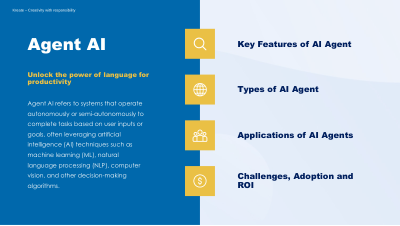
Artificial Intelligence is moving beyond simple chat interfaces and prediction models. We are entering the era of Agent AI—intelligent systems designed to act autonomously, learn continuously, and execute complex, goal-oriented tasks. These agents are the next generation of digital workers, capable of turning instructions into tangible outcomes without constant human oversight.
Key Features Defining Agent AI
What makes an AI an "Agent"? It is a combination of sophisticated capabilities that allow them to perceive, reason, and act within their environment. The core features include:
- Autonomy: Agents make decisions and perform actions without continuous human intervention, ranging from simple automation (scheduling) to complex strategy (financial trading).
- Learning Capabilities: Using machine learning, agents adapt their behavior based on new data, user interactions, and past experiences, constantly improving their performance over time.
- Goal-Oriented Behavior: They are engineered to achieve specific, defined goals, whether it’s finding the most efficient logistical route or maximizing sales through personalized outreach.
- Interaction with the Environment: Agents perceive and react to their surroundings. This could be a physical world (in robotics) or a digital environment (interacting with APIs, websites, and applications).
- Reactivity and Proactiveness: Agents can respond instantly to real-time events (reactive) or anticipate needs and potential problems before they arise (proactive), such as predictive maintenance systems.
These features allow AI Agents to serve as specialized digital assistants, automating workflows and freeing up human capacity for more creative and strategic tasks.
The Spectrum of AI Agents
Not all AI agents function the same way. They can be classified based on their level of complexity and reasoning:
- Reactive Agents: These are the simplest, acting purely based on the current state of the environment with no memory of past actions or long-term plan.
- Deliberative Agents: These maintain a model of the world, can use reasoning, and plan sequences of actions to achieve their goals.
- Hybrid Agents: Combining the strengths of both, they offer immediate responses to urgent changes while maintaining a long-term strategy for complex goals.
- Utility-Based Agents: They evaluate potential actions based on a utility function, always choosing the path that maximizes their desired outcome or performance measure.
- Learning Agents: These agents, often employing Reinforcement Learning, continuously adjust their behavior and knowledge structure based on rewards and experiences.
Transformative Impact and Use Cases
AI Agents are already delivering significant value across various industries, fundamentally changing how businesses operate:
- Task Automation: Automating repetitive, time-consuming tasks like data entry, customer support, and scheduling, which drastically increases productivity.
- Tailored Experiences: Analyzing user behavior and preferences to offer highly personalized services, from custom financial advice to hyper-relevant product recommendations.
- Data-Driven Insights: Agents can rapidly analyze massive, unstructured datasets—the "dark data"—to uncover patterns and insights that enhance decision-making in real-time.
- Multi-Agent Systems: Complex tasks are achieved by systems where multiple agents collaborate or compete, such as autonomous drone swarms or sophisticated smart grid management.
The rise of Agent AI marks a shift from tools that assist to systems that act. By building specialized AI workers, organizations can unlock unprecedented levels of efficiency, personalization, and data access.